Podcast: Play in new window | Download (Duration: 40:27 — 37.1MB) | Embed
Subscribe: Apple Podcasts | RSS
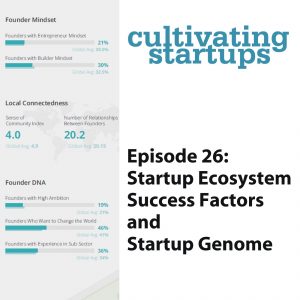 Lots of ideas for startup ecosystem builders to discuss, debate, adapt and adopt in the 2018 Startup Genome report. It’s one of the few examinations of what world-class ecosystems look like and how to get there—and something that every ecosystem organization should read and consider.
Some of the topics discussed on this episode:
Local Connectedness: New in this year’s report and a critical component of all strong ecosystems. We give a big thumbs up to the report’s contention that “collisions” and events aren’t enough to build a startup community.
Subsectors: Startup Genome looks at the growth of “deep tech”—technology subsectors that are typically more research-heavy and attract older, more experienced and educated founders. They see these subsectors as an opportunity for smaller ecosystems to become leaders. We look at what they identify as the subsector strengths of Canada’s ecosystems.
Founder Mindset: Are there attitudes and traits that are more likely to lead to strong startup founders or business builders? Startup Genome has introduced a new factor that looks at what traits help founders succeed.
And we look at why we still think the Startup Genome reports are must-reads even though we give little credence to their rankings—and why we worry that the Ontario government may be latching on to the wrong takeaways from these reports.
 The Canadian federal budget was delivered on Tuesday and we start the show with a quick look at two items that may not get a lot of attention but may have a big impact on the startup ecosystem.
 An expert review panel recently completed a report on the Ontario Network of Entrepreneurs (ONE)—the main program of the Ontario government for providing funding to organizations supporting tech or innovation companies and startup ecosystem. The ONE’s Regional Innovation Centres are located in 18 cities across Ontario.
 We’re back this week and it’s the show we can only do once every five years. What are the fastest growing tech/ICT/software centres in Canada? You’ll see rankings like this all the time, but we really only have good data on this every five years when the Census numbers come out. And they just came out and we go through them on this week’s show—while also looking at why it’s not as simple to come up with these rankings as you may think.
 Hot DesQ is a program run by the government of Queensland in Australia through its Advance Queensland initiative to bring startups from around the world to Queensland and get them engaged with the local startup community. Through the program, startups receive $50,000-$100,000 in funding plus space at a coworking site in Queensland of their choice for six months. In return, startups agree to participate in local startup activities and build connections with companies in Queensland, while passing along some of their experience in growing a startup and building startup communities.
 Montreal is home to one of Canada’s largest and most dynamic startup ecosystems, and in just a few years, Isaac Souweine has gone from being a newcomer to the city (and to Canada) to being at the centre of the startup community as EIR with
  Velocity is one of Canada’s most successful university-based startup incubators and an integral part of the Waterloo startup ecosystem. Its success helped the Ontario government see university incubators and accelerators in a whole new way, leading to the creation of a multimillion-dollar program across the province to fund “campus-linked accelerators.”